Battery storage in Georgia has moved well beyond being an optional upgrade for solar owners. For homeowners, a properly designed battery can keep important circuits—or an entire home—operating during an outage while allowing more solar energy to stay onsite. For businesses, batteries can become part of a larger energy-management strategy built around resiliency, peak-demand control and reducing dependence on grid electricity. Nonprofits can benefit for many of the same reasons while potentially having access to federal clean-energy incentives through elective-pay provisions.
The important question is no longer simply, “Should I buy a battery?” It is: What size battery, inverter and control strategy actually makes financial and operational sense for this property?
Custom Solar Solutions designs solar and battery storage systems around the electrical demands of each property instead of forcing customers into a one-size-fits-all package. The Sandy Springs-based company reports more than 3,000 completed solar designs and installations, more than 30 years of experience, and a 100% in-house team of NABCEP-certified and state-licensed professionals serving Georgia.
Thinking about battery storage for your Georgia home, business or nonprofit? Start with a load and profitability analysis rather than simply choosing a battery online.
Request a solar and battery storage evaluation from Custom Solar Solutions.
Is Battery Storage Worth It in Georgia in 2026?
For many properties, yes—but the reason can be different from one customer to another.
A homeowner may primarily value backup power during thunderstorms, ice events or utility outages. Someone who already owns solar may want to store energy that would otherwise leave the property. A business may be more interested in reducing peak demand, preserving operations during an outage or pairing battery storage with a larger solar investment. A church, school or nonprofit may be evaluating resilience along with federal clean-energy incentive opportunities.
Georgia’s utility structure also makes self-consumption worth examining. Georgia Power’s 2026 RNR Instantaneous Netting program credits eligible excess solar generation at an avoided-cost rate of 3.2188 cents per kWh plus an additional 4 cents per kWh, or 7.2188 cents before considering individual billing circumstances. That means electricity consumed directly onsite can have substantially different economics from electricity exported to the grid. See the current Georgia Power solar program information.
A battery can capture some daytime excess solar and make that electricity available later. But that does not automatically mean every battery has a great payback. Equipment cost, usable capacity, round-trip efficiency, daily energy profile and battery cycling strategy all matter.
That is precisely why battery storage in Georgia should be engineered around actual energy data rather than sold by battery count.
What Does a Home Battery Backup System Actually Do?
Solar panels produce electricity when sunlight is available. Without storage, electricity not being consumed by the property either flows back toward the utility where permitted or is otherwise managed according to the system and utility configuration. Battery storage adds the ability to retain electricity and use it later.
During normal operation, that stored energy might be used after sunset, when household consumption rises, or according to programmed energy-management settings. When the grid fails, a properly configured home battery backup can disconnect from the utility and continue powering designated loads.
That distinction—properly configured—is important.
Installing a battery does not automatically mean your entire home will operate normally during a blackout. A 5,000-square-foot home running multiple air conditioners, pool equipment, ovens, water heaters and EV charging has a completely different power requirement from a home that only needs refrigeration, internet, lighting and a few outlets.
Custom Solar Solutions begins residential battery design by identifying what the customer actually wants to keep running.
Explore residential solar and battery options in Georgia.
Whole-Home Battery vs. Essential-Load Backup
One of the biggest decisions when shopping for residential battery storage in Georgia is whether you want essential-load backup or whole-home battery backup.
Essential-load systems prioritize selected circuits. Refrigerators, lighting, internet equipment, garage doors, security systems, well pumps, medical devices and strategically selected outlets can often provide a high level of comfort without attempting to power every appliance simultaneously.
Whole-home systems require more planning. Battery capacity measured in kilowatt-hours tells you how much energy is available, while inverter output measured in kilowatts determines how much power can be delivered at one time. Both matter.
A battery may contain enough stored energy to operate your home for many hours but still be unable to start several large loads simultaneously if the inverter cannot provide the required output. Conversely, an extremely powerful inverter attached to insufficient battery capacity could operate large loads but only for a short period.
This is where equipment selection becomes critical.
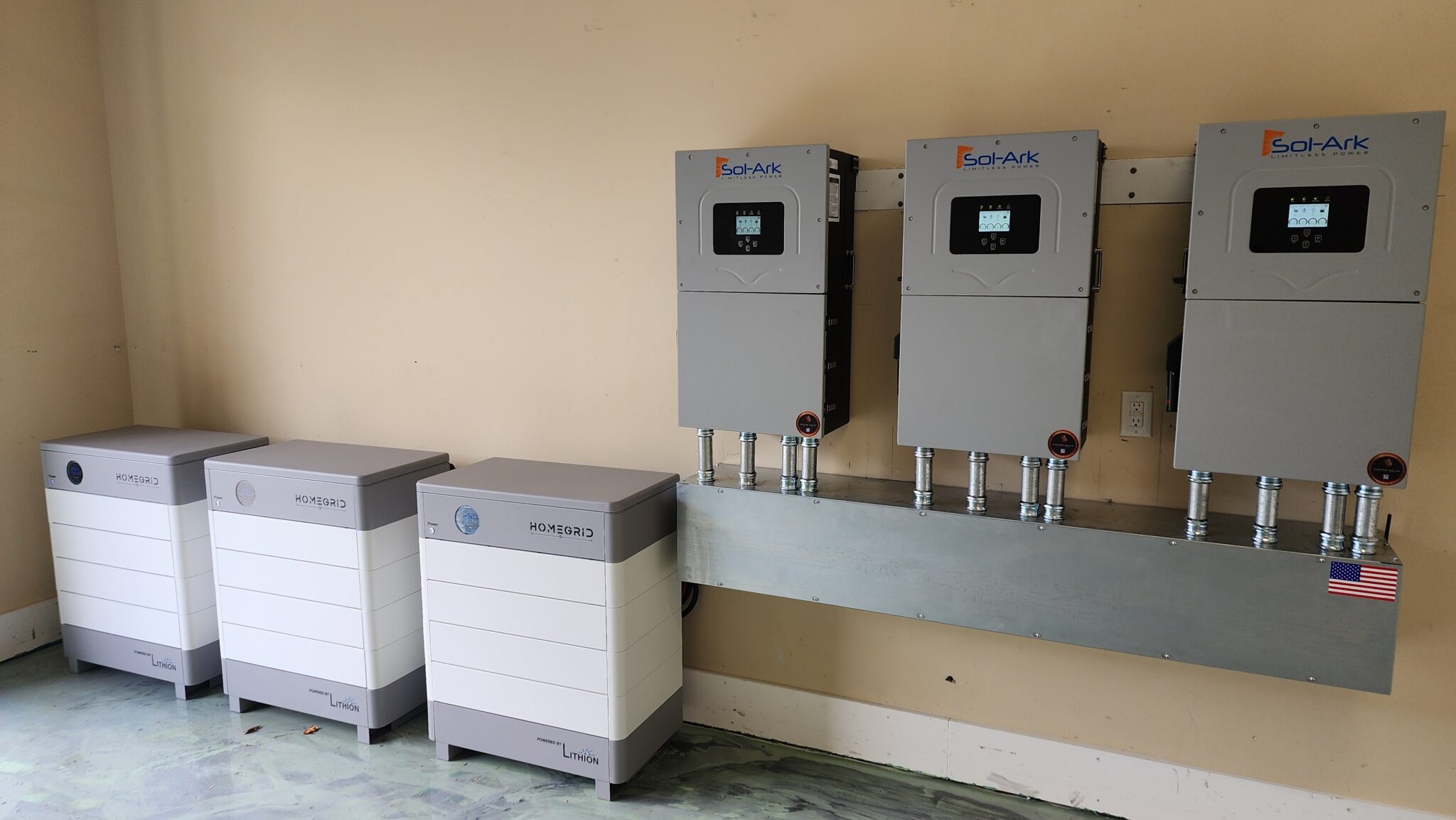
HomeGrid Battery Storage for Georgia Homes and Businesses
Custom Solar Solutions installs HomeGrid battery storage systems for properties requiring scalable storage.
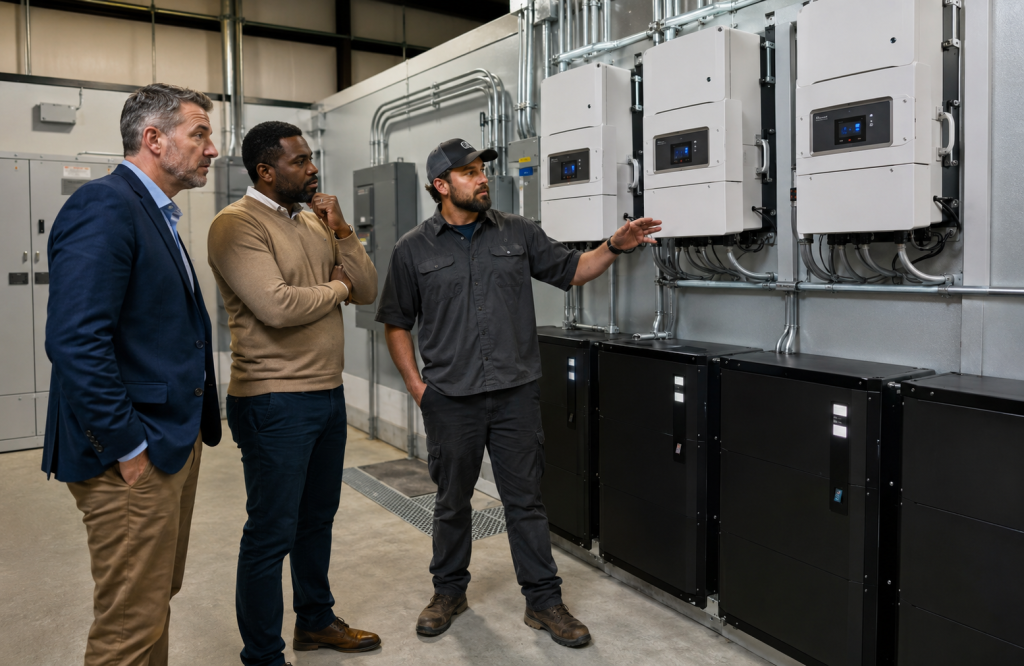
HomeGrid’s Stack’d architecture is modular: individual modules provide 4.8 kWh, while a single Stack can accommodate up to eight modules for 38.4 kWh of capacity. The manufacturer lists continuous output of up to 14.4 kW and a short-duration surge of up to 24 kW, making the platform relevant to larger residential loads and certain small-business applications.
The modular approach is particularly useful because battery storage requirements can change.
A family might initially prioritize overnight consumption and outage protection but later add an EV, additional HVAC equipment or more solar panels. A growing business may need additional storage as equipment and operational hours expand. Designing an expandable architecture at the beginning can reduce the likelihood that the entire system needs to be replaced later.
HomeGrid also uses lithium iron phosphate, or LFP, chemistry for its stationary storage products.
Why Sol-Ark Hybrid Inverters Matter
The battery receives much of the attention, but the inverter can be equally important.
Custom Solar Solutions offers Sol-Ark hybrid inverter solutions for residential and commercial applications. Hybrid inverters can coordinate solar generation, battery charging and discharging, grid interaction, backup loads and—in properly engineered systems—additional power sources.
For residential applications, the Sol-Ark 15K platform provides 15 kW AC output, up to 12 kW AC from batteries and 200-amp grid pass-through.
Commercial systems can scale much further. Sol-Ark’s commercial equipment includes 30K three-phase 208V and 60K three-phase 480V architectures. The manufacturer states that its 60K platform can support configurations ranging up to approximately 9.6 MWh of battery capacity, depending on system architecture.
Monitoring is another important part of a modern energy-storage installation. Sol-Ark’s current monitoring platform provides remote system-management capabilities, and the manufacturer states that its platform is hosted on U.S.-based AWS servers.
The result is not simply a battery sitting on a wall. A sophisticated battery storage system becomes an integrated energy-management platform.
How Much Does Battery Storage Cost in Georgia?
There is no responsible single price for battery storage because capacity alone does not determine installed cost.
A straightforward essential-load retrofit to an existing compatible solar system is fundamentally different from designing a multi-battery whole-home system with new hybrid inverters, service equipment, load management, electrical-panel modifications and generator integration.
National laboratory cost modeling illustrates why quotations vary so widely. The residential battery benchmark separates battery-pack cost, bidirectional inverter cost, supply-chain expense, electrical and structural components, labor, engineering and other project costs. The representative residential system used in the benchmark is 5 kW/12.5 kWh, but actual Georgia installations can be substantially smaller or larger depending on the property’s objectives.
For commercial battery storage, project size varies even more. National modeling examines systems from roughly 100 kW through 2,000 kW and storage durations ranging from one to eight hours. Accurate duration sizing is especially important because adding energy capacity changes both system cost and the number of hours a facility can operate from stored electricity.
A proper Custom Solar Solutions proposal therefore evaluates:
- Existing electricity consumption and interval data when available
- Critical loads and desired backup duration
- HVAC, pumps, motors and other high-starting-current equipment
- Existing solar production or planned solar capacity
- Main electrical service and panel configuration
- Battery capacity and inverter output
- Potential future EV charging or electrification
- Utility rate structure
- Applicable tax and utility incentives
- Equipment location, permitting and installation requirements
The goal isn’t to sell the most batteries. It is to determine the least amount of equipment that can reliably accomplish the customer’s objectives.
Where Do the Real Battery Savings Come From?
Battery savings rarely come from one source.
For a homeowner, part of the value can come from using more solar energy onsite instead of exporting it. Another part may come from shifting electricity consumption to more favorable periods under applicable utility rate structures. Backup power also has an economic value that rarely appears on a standard solar calculator: avoided spoiled food, hotel stays, generator fuel, interrupted home-office work or loss of essential electrical equipment.
Businesses can have additional opportunities.
Commercial utility bills may contain demand-related charges based partly on how much power a property draws during its highest-demand periods. Battery systems can be configured to discharge when facility demand approaches a predetermined threshold, a strategy commonly called peak shaving. Commercial hybrid-inverter systems are specifically designed to support applications such as peak-demand management and energy optimization.
Consider a simplified example. If a facility could consistently reduce its billed peak by 20 kW and its applicable tariff valued that reduction at $15 per kW, the theoretical reduction would be $300 per month, or $3,600 annually, before accounting for battery losses, seasonal tariff rules or other charges.
That is an illustration—not a promise of savings. The real analysis requires the business’s actual utility tariff and load profile.
Business Battery Storage Can Do More Than Provide Backup Power
For Georgia businesses, business battery storage can serve several purposes simultaneously.
A warehouse may use storage to reduce short bursts of electrical demand from HVAC and equipment. A manufacturing facility may prioritize keeping selected production processes running. A medical, professional or technology facility might place higher value on continuity. Retail operations may want refrigeration, lighting, point-of-sale equipment and networking to survive shorter outages.
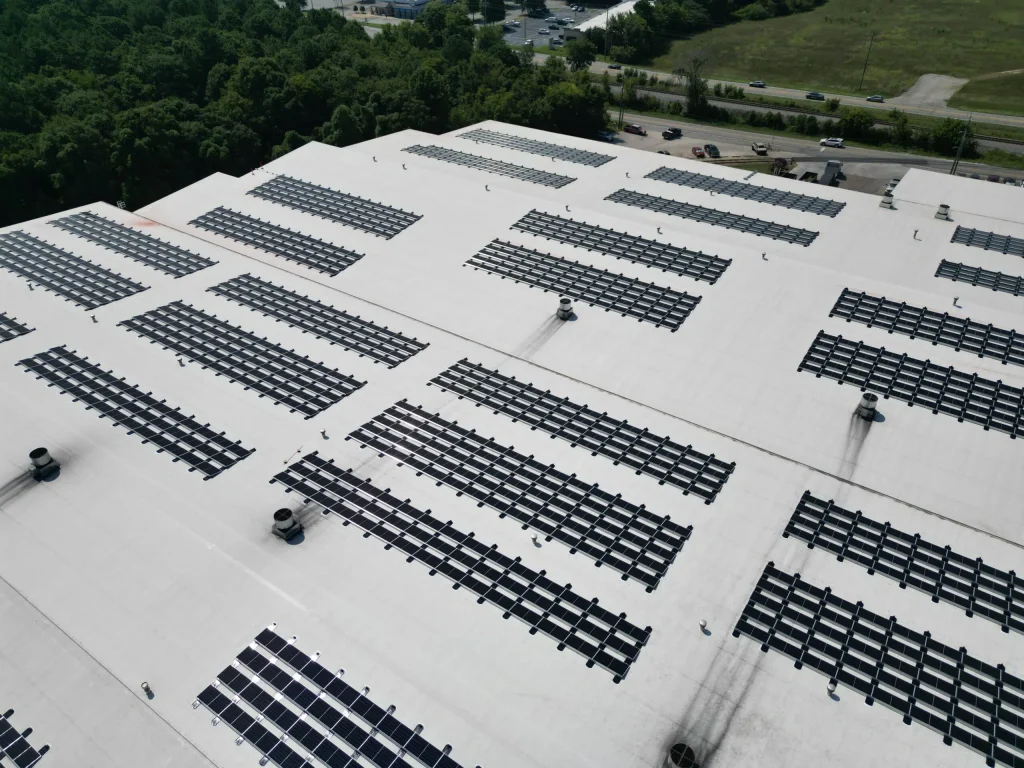
Battery storage can also complement solar because many commercial facilities consume substantial electricity during daylight hours. Solar offsets part of that load directly, while storage can capture excess generation or support demand management later in the day.
Custom Solar Solutions designs commercial solar and battery systems around actual facility operations rather than residential-style assumptions. The company lists commercial, industrial and customized installations among its project capabilities.
Federal Battery Incentives for Businesses in 2026
Commercial battery storage has an important advantage over new residential installations in 2026: qualifying energy-storage technology may still be eligible for the federal Clean Electricity Investment Credit under Section 48E.
Current IRS guidance lists a 6% base investment credit, with qualifying projects potentially reaching 30% when applicable prevailing-wage and apprenticeship requirements are satisfied. Additional increases may potentially apply for qualifying domestic-content and energy-community projects. Eligibility is project-specific, and new prohibited-foreign-entity sourcing restrictions can also affect qualification. Businesses should have their CPA or tax counsel confirm eligibility before relying on any incentive in an investment model. See the current IRS Clean Electricity Investment Credit guidance.
Certain qualified clean-energy facilities and energy-storage technologies may also qualify as five-year property under MACRS cost-recovery rules.
For a sizable commercial project, those provisions can materially change after-tax economics.
Battery Storage for Georgia Nonprofits, Churches and Community Organizations
Battery storage can also be compelling for nonprofits.
A church could maintain lighting, communications and refrigeration during an outage. A school or community organization might prioritize emergency operations. Food banks, shelters and charitable facilities can have electrical loads where reliability has value beyond the utility bill.
Historically, tax-exempt organizations could not benefit directly from many federal income-tax credits because they owed little or no federal income tax. Elective pay changed that for qualifying clean-energy credits.
The IRS currently lists 501(c) organizations and other qualifying tax-exempt entities among those potentially eligible to use elective pay. Section 48E is among the credits eligible for the program, provided the underlying project meets the applicable requirements and the organization completes the required pre-filing registration.
That makes solar plus storage worth evaluating for churches, charities, private schools, foundations, community organizations and other qualifying Georgia nonprofits.
Georgia Is Moving Toward More Battery Storage
Battery storage is not merely a residential trend.
Georgia Power’s approved 2025 Integrated Resource Plan includes substantial utility-scale battery deployment and a new solar-plus-storage initiative aimed at residential and small-commercial customers. Georgia Power has also described plans for more than 1,500 MW of battery energy storage in coming years, including customer-sited storage initiatives.
That does not mean a homeowner should purchase equipment today based on an assumed future utility payment. Programs, enrollment rules and compensation can change.
It does show where Georgia’s electrical system is heading: flexible energy storage is becoming increasingly important for both grid-level and customer-level energy management.
Real Georgia Battery Storage Experience
Battery-storage recommendations should come from installers who actually build and service these systems.
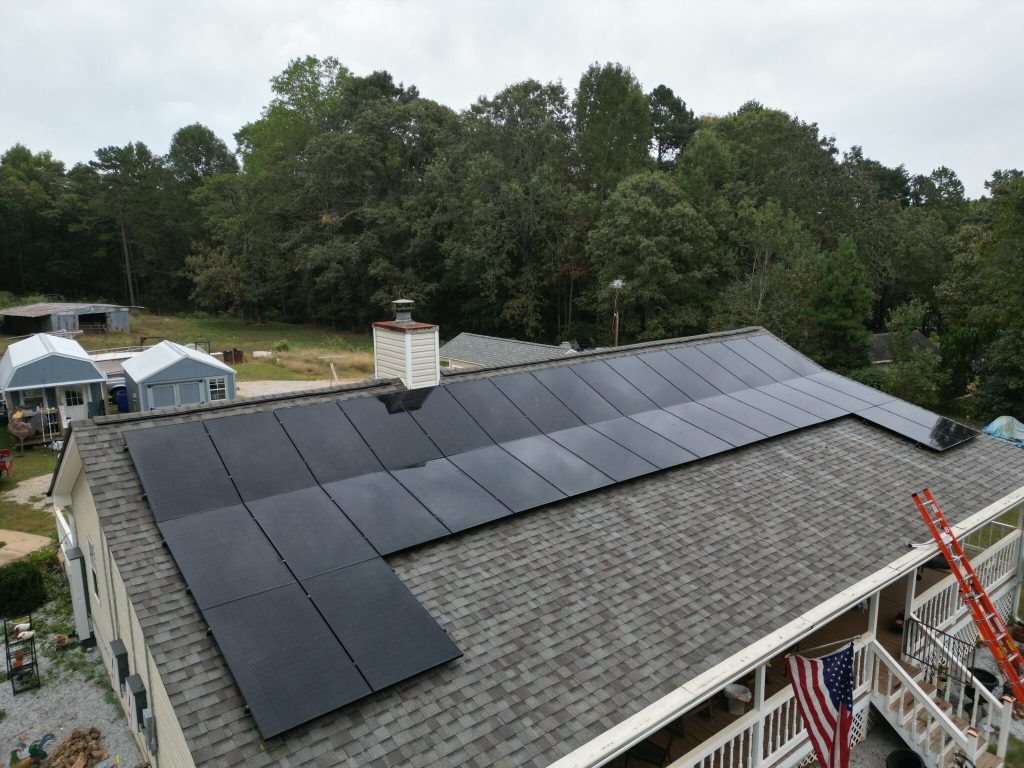
Custom Solar Solutions’ published project gallery includes a Georgia residential installation with more than 100 solar panels and full battery backup, demonstrating experience well beyond basic cookie-cutter residential arrays.
Another published customer experience describes adding battery storage to an existing rooftop solar system. The homeowner reported successfully moving through multiple grid-down events while continuing to operate lights, refrigeration, internet, television, fans and even air conditioning. The same customer reported seeing many days around 98% grid independence after adding storage. That is one customer’s experience rather than a guaranteed result, but it demonstrates what properly matched solar and storage can accomplish.
Other customer feedback published by Custom Solar Solutions includes work on a large off-grid farm system and repairing or expanding systems originally installed by other solar companies.
Those projects matter because battery storage requires more than equipment installation. Load calculations, inverter programming, electrical integration, commissioning and long-term monitoring can determine whether the finished system actually performs as expected.
Residential Battery Storage Near Me in Georgia
Custom Solar Solutions is headquartered in Sandy Springs and serves customers throughout Atlanta and surrounding Georgia communities. Service areas include Sandy Springs, Roswell, Alpharetta, Marietta, Decatur, Brookhaven, Dunwoody, Johns Creek and additional communities throughout Georgia.
The company provides residential battery storage, whole-home battery backup, solar integration, commercial battery systems, system monitoring, maintenance and battery expansion services. Its maintenance operation services battery energy-storage systems as well as solar PV equipment, including systems the company did not originally install.
If you’re searching for battery storage near me in Georgia, compare more than the battery brand. Ask who performs the load analysis, who designs the electrical system, who completes the installation, how monitoring is commissioned and who you call five years later if the system needs service.
Is Battery Storage Right for Your Property?
The best candidates for battery storage usually have a clear objective.
You may be a strong candidate if you want:
- Backup power during Georgia grid outages
- Greater use of the solar electricity you generate
- Whole-home or essential-load resiliency
- Reduced dependence on a fuel-powered generator
- Commercial peak-demand management
- Energy continuity for critical business operations
- Expandable storage for future electrical loads
- A solar-plus-storage strategy for a nonprofit or tax-exempt organization
The wrong approach is selecting a battery first and figuring out what it can power afterward.
Custom Solar Solutions starts with your utility bills, electrical loads, backup requirements and financial goals.
Get a Free Georgia Battery Storage Evaluation
Want to know whether battery storage will actually benefit your property?
Custom Solar Solutions can evaluate your electricity usage, existing solar system, utility rate structure, electrical equipment, backup priorities and potential incentive opportunities. From there, the team can recommend an appropriately sized battery and inverter configuration rather than an oversized package.
Request your free home, business or nonprofit battery storage and profitability evaluation today.